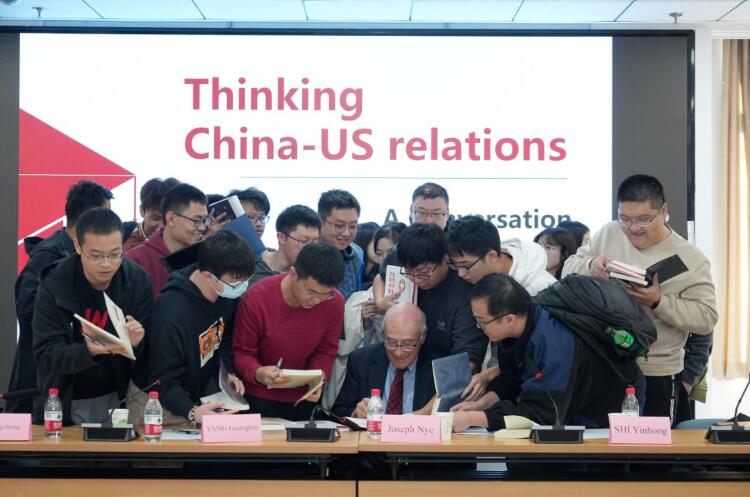
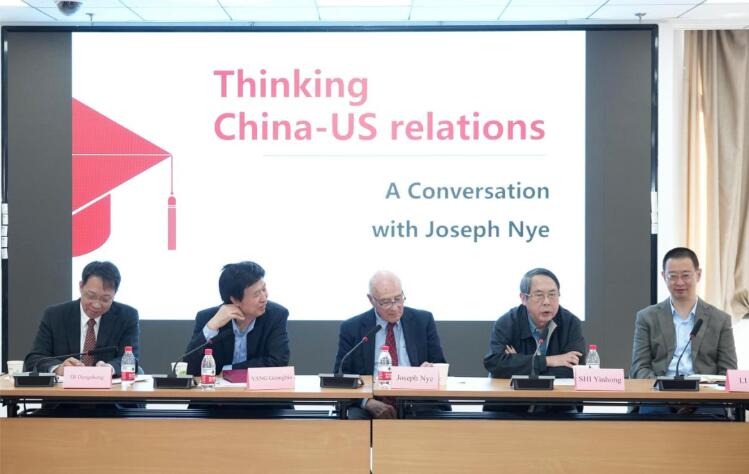
On the morning of October 24, 2023, Professor Joseph Nye Jr., Distinguished Contribution Professor of Harvard University and former dean of the Kennedy School of Government, was invited to visit the School of International Relations of Renmin University of China to have a two-hour exchange and discussion with teachers and students of Renmin University of China on China-Us relations. More than 20 teachers and experts from the School of International Relations, Renmin University of China, Hillhouse Artificial Intelligence School, Law School, Marxism School, World Knowledge Publishing House, as well as students of related majors and international students participated in the exchange and discussion. Li Chen, vice president of the School of International Relations, moderated the discussion.
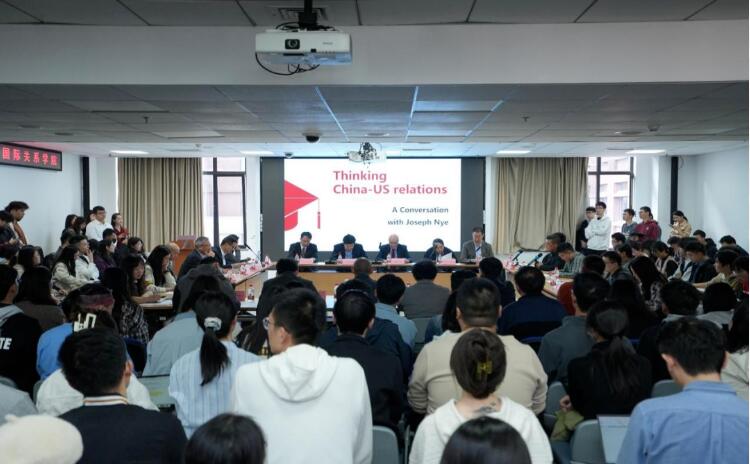
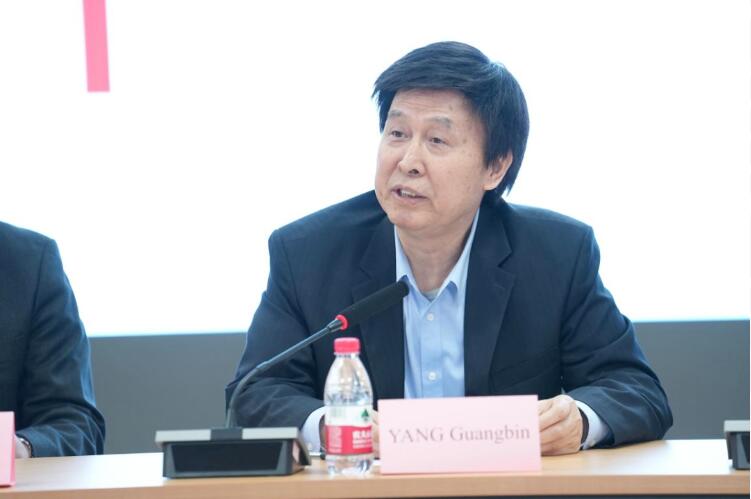
Dean Yang Guangbin made an opening speech and welcomed Professor Nye and all the teachers and students. Dean Yang Guangbin pointed out that Professor Nye’s theoretical research and classic works have a great impact on teachers and students in the field of international relations, introduced the theoretical innovation and research progress of the school, and stressed the need for exchanges with top international scholars in the process of discipline construction and talent training, so he is very much looking forward to the upcoming wonderful dialogue.
In his keynote speech, Professor Joseph Nye Jr. first said that he was very happy to be back in China after four years of COVID-19, and he looked forward to today’s discussion to communicate different views and develop real dialogue.
Professor Nye pointed out that looking back at Sino-US relations since 1949, there seems to be a phase every 20 years. During the first two decades of the Cold War, China and the United States faced off against each other. President Nixon’s visit to China in 1972 began a phase of “quasi-alliance” against the Soviet Union, and the end of the Cold War ushered in a third phase, a period of deepening economic and social ties and contacts. Since 2015, Sino-US relations seem to have entered a new chapter of “great power competition”, and Professor Nye pointed out that there are problems in understanding today’s term “new Cold War”. “New Cold War” can be used to describe the state of comprehensive competition, but in the real context, the Sino-US relationship today is very different from that during the Cold War. Interdependence still exists, and there is no prospect of complete decoupling in the economic field. The “small courtyard wall” involving technology and security has brought about partial decoupling, and it also faces the dilemma of the continuous expansion of the “small courtyard” area. At the same time, there are great prospects and needs for economic and ecological cooperation between China and the United States, such as large-scale economic and trade exchanges and joint responses to problems such as atmospheric damage, melting ice caps, and rising sea levels. These exist to ensure that the two countries must cooperate, otherwise there will be devastating consequences for both countries and the world. This is where soft power can come into play.

Whether Kevin Rudd calls for “Managed Competition”, Prof Nye argues, Both “Competitive Coexistence,” as emphasized by Antony Blinken at the Aspen Security Dialogue, have inherent contradictions that pose challenges to the world. Professor Nye pointed out that it is noteworthy that both China and the United States pose existential threats to each other, and both need to manage competition while maintaining cooperation to address key issues such as the epidemic, the environment, and economic and financial stability. No matter how long the current situation lasts, all parties involved need to find a balance between competition and cooperation. In addition to preventing the misreading of the lessons of the Cold War, we should also pay attention to the lessons of 1914, when great powers slipped into war through miscalculation.
During the discussion and exchange session, Yin Hong, Zhai Dongsheng, Luo Tianhong, Sun Hao, Liu Yang and An Gang gave speeches successively.
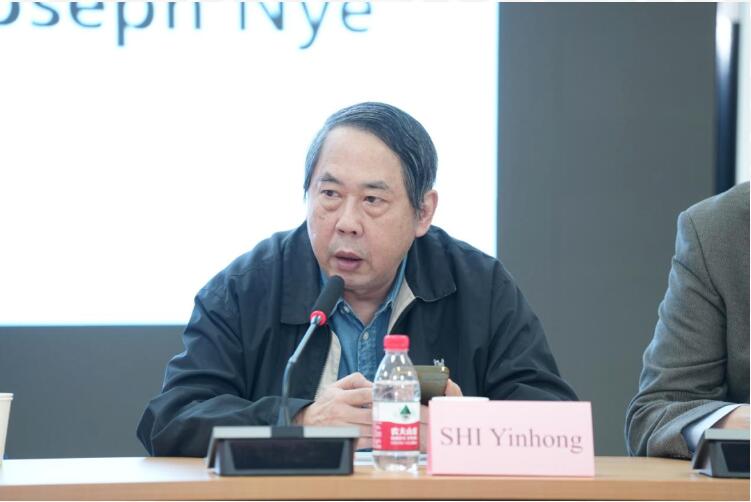
Professor Shi Yinhong of the University of International Relations elaborated on the influence of diplomatic strategy tradition, strategic goal determination, means selection, decision-making system, internal and external linkage and other factors on soft power.
Professor Zhai Dongsheng, director of the Institute of Regional Studies at Renmin University, first thanked Professor Joseph Nye for his candid comments on China-Us relations, and raised different views from the Chinese perspective, such as the domestic political and economic momentum after the 2008 financial crisis. Zhai then raised some questions about the practical application of soft power. First, the changing trend of US soft power under the influence of domestic politics; Second, what methods should China use to enhance its soft power in the so-called competitive and cooperative relationship?
In response to Nye’s speech, Associate Professor Luo Tianhong of the School of International Relations said that there is a discrepancy between the concept and practice of the international order, and even the problem of exclusivity is worthy of attention. Professor Luo also raised questions about the current status and development of liberal international relations theory and the influence of various theoretical schools in the United States.
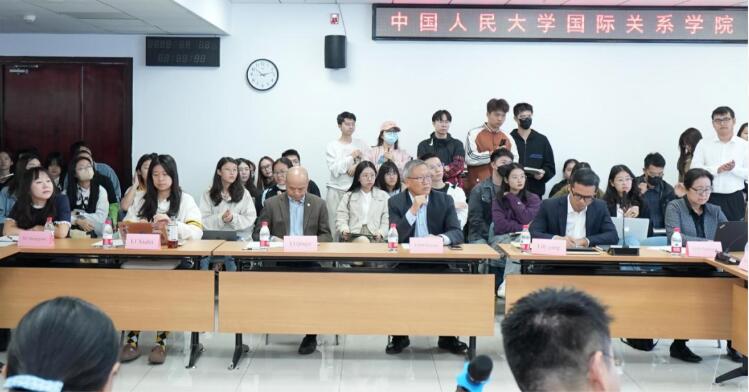
Sun Hao, associate professor of Gao Ling Institute of Artificial Intelligence, raised the possibility of future Sino-US cooperation in specific functional fields from the perspective of artificial intelligence scientists, pointing out that scientific and technological cooperation is mainly generated at the level of companies rather than between governments, and many potential problems may arise in the future if governments fail to formulate common rules and laws. Second, government leaders need to come up with healthy competition mechanisms to avoid conflicts. Third, there are many problems in the world today, such as climate change and terrorism, and AI technology may help contribute to the solution; Finally, the common challenges facing the development of AI technology, such as fairness, privacy, ethics and other issues, need to be solved by the cooperation between China and the United States in the future.
Liu Yang, Assistant professor of the Law School, explained the “rules-based world order” from the perspective of international law, pointed out its relationship with the credibility of the United States, and discussed the core interests of both China and the United States, proposing that the premise of regulating competition is to respect the core interests of both sides. In addition, Professor Liu Yang proposed that the foundation of cooperation is to build trust, and the future of the international mechanism needs to strike a balance between building trust and seeking competition.
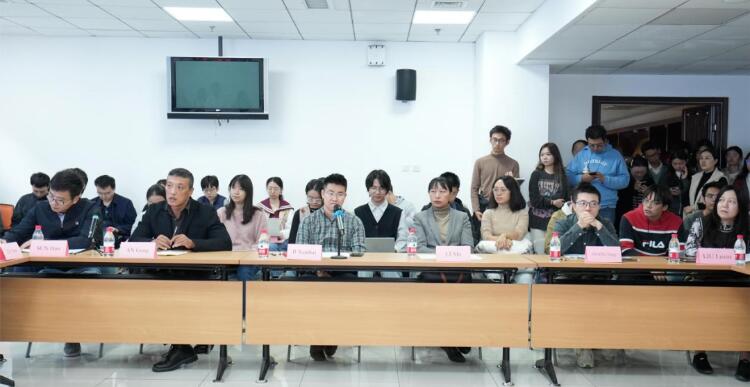
An Gang, editor of World Knowledge magazine and a special expert at the Center for Strategic and Security Studies at Tsinghua University, pointed out that although the idea of cooperative competition is more influential, the two sides also need to prevent the emergence of non-cooperative competition, maintain dialogue and peaceful coexistence with a responsible attitude toward the future, and prevent miscalculation of each other’s core interests and strategic goals.
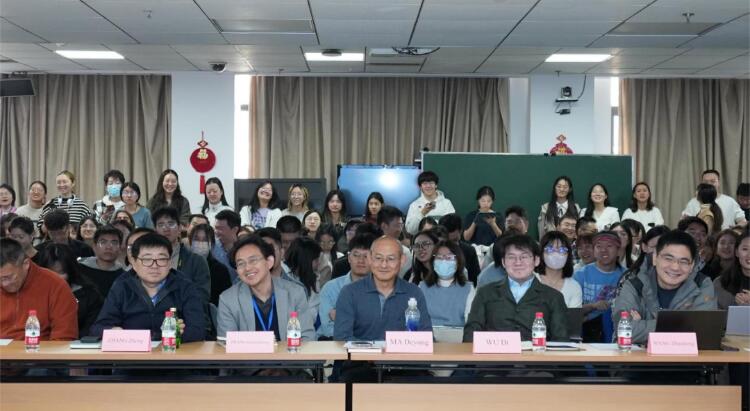
Based on the discussion and questions of the scholars, Professor Joseph Nye responded by comparing the soft power of China and the United States, and proposed that soft power can achieve its goals through its own attractiveness, which can be used for both competition and cooperation, and should play a role in managing Sino-US relations. He also pointed out that universities are an important source of soft power. Professor Nye stressed that cooperation at the institutional level still exists, and that communication can lead to a better understanding of each other’s positions, which is good for both countries and the world. For the development of international relations theory, Nye believes that the balance of power and other issues concerned by realism theory are the starting point for understanding international issues, which has certain value, but the observation and understanding of international issues can not be stagnant in the perspective of realism.
Professor Li Shi, Associate Professor Ji Xianbai and other students from the School of International Relations participated in the supplementary questions, and discussed further with Professor Joseph Nye on the evolution and applicability of the liberal school of theory, the concept of limited war and historical cases, and “Thucydides Trap”. The seminar ended with warm applause from the audience. After the meeting, the students actively exchanged and interacted with Professor Nye.